UPDATE: July 4, 2026
The same plot, a new client? Growing questions around Nomad City investments.
Can the same story repeat itself multiple times? In recent weeks, several investors have contacted us claiming that their properties – plots or apartments – are being offered to new clients, even though they previously signed contracts and paid substantial sums.
One of those affected described their situation. According to them, their brother-in-law was told by a Samana Group representative that “this plot became available because the previous client had to withdraw from the investment due to health problems.”
The problem is that – according to our source – they had not yet withdrawn from the investment.
To date, three people have told us similar stories about “a client withdrawing from the investment.” Are these isolated cases? Or do they form part of a much larger puzzle?
This leads to further questions: if – according to clients – more than half of those who signed Promise to Sell agreements have withdrawn from the investment or are awaiting a refund due to failure to deliver properties within the contractually agreed deadlines, could the rights to the same plots and apartments have been offered to subsequent buyers? If so, the scale of the problem could be far greater than currently known.
“After paying $150,000, I was told I hadn’t bought anything”
At the beginning of June, we received a message from “Sophie” (name changed at her request), an investor from the United States. According to her account, she received a message from Zmysłowski stating that she “had not purchased any property, but had merely reserved a plot.”
Sophie makes no effort to hide her surprise. As she writes to our editorial team, she has so far paid over $150,000 USD.
“How is it possible that after paying so much money I am treated this way? When we met on the Google Meet platform in 2025, he was extremely polite and charming. His wife – Yaritza – charmed me with her comments. They even invited me to lunch in New York.”
Today – as Sophie informs us – together with a law firm from the Dominican Republic, she is preparing further legal steps.
“The construction site is dead”
We also received a message from a resident of Santo Domingo who regularly visits family living near Monte Rojo and says they drive past the Nomad City investment site two or three times a month on average.
“The construction site is dead. The same two or three people walk around it. Nothing is happening there.”
The author of the message admitted they had themselves considered purchasing a property in the project. They ultimately decided against it – after three years without seeing any construction progress, they chose to invest in a different project in Las Terrenas.
More accounts. More questions.
Each of the stories presented is individual. But taken together, they paint a picture that cannot be ignored. Recurring reports of delays, waiting for refunds, disputes with clients and the alleged offering of the same properties to successive investors should prompt particular caution.
At this stage, these are the accounts of people who have contacted our editorial team. We will continue to verify them and remain open to the position of Samana Group and Zmysłowski.
WANT TO SHARE YOUR STORY? WRITE TO US.
You can do so discreetly: scamsamanagroup@proton.me
UPDATE: July 2, 2026
Another month passes. The silence continues.
Weeks go by, yet the representatives of Samana Group have still not published any new announcement. There is no information about the work schedule, the company's financial condition, or the deadlines for fulfilling previously made promises. Instead of answers, there is only silence.
Meanwhile, lenders are still waiting for the return of funds they transferred to the company — funds that in practice only the company's CEO, Marek Zmysłowski, has access to. Every additional month without concrete explanations raises new questions and deepens distrust in the entire venture.
Paradoxically, instead of information about construction progress, the company is presenting a new website and continues to encourage further investments. On the official portal, one can find a NOMAD CITY 3 tab, even though — according to available information — not a single property within the Nomad City 1 project has been completed to this day.
Is the priority the realization of investments, or merely image-building and attracting new payments?
How long will investors, clients and lenders continue to finance the company's operations without receiving the expected results? Are the funds being used in accordance with the declared purpose? Does the CEO's lavish lifestyle — including his apartment on Złota 44 Street in Warsaw and his passion for car rallying — not stand in contradiction to the difficult situation of those waiting to get their money back?
But these are only the beginning of the questions.
- Why have reliable reports on investment progress been missing for months?
- Where are the funds deposited by investors and lenders?
- How much money was actually allocated to construction, and how much to the company's current operations?
- Why are new projects being launched when previous ones remain unfinished?
- Who is making decisions about launching new investments despite outstanding debts to creditors?
- How long can new funds be raised without accounting for previous obligations?
- Do investors receive a full picture of the company's financial situation before deciding to invest?
- Why do marketing activities take precedence over information about construction?
- Are new investments meant to finance previous obligations, or do they genuinely serve the realization of new projects?
- Where does bold business vision end and a model based solely on the trust of successive investors begin?
For now, there are no answers. And the longer the silence lasts, the more questions and speculation arise. Because in business, trust is built through transparency — not through new tabs on a website.
UPDATE: June 18, 2026
No general meeting in SAMANÁ Group REH. Questions are mounting.
The last General Meeting of Shareholders of SAMANÁ Group REH took place in December 2024. Since then – despite the passing of the subsequent months of 2025 – no further meeting has been convened, although in corporate practice meetings of this type should take place at least once a year to approve the company's key financial and operational decisions.
For some investors, the absence of another meeting is not just a formal delay. It is a signal that the fundamental mechanisms of owner supervision may not be functioning in a transparent manner. Indeed, the general meeting is not only a statutory obligation – it is the only moment when shareholders can formally approve financial statements, analyze the management board's actions, and make decisions regarding the company's key assets.
Meanwhile, in the case of SAMANÁ Group REH, no such moment occurred in 2025.
Silence after December 2024
According to available information, the last meeting was held in December 2024. Since then, investors have received neither confirmation of a new date nor any official communication explaining the reasons for failing to convene the required formal meetings.
Importantly, some shareholders also point out that in the past there were problems with invitations to meetings, which – if confirmed – may raise questions about the equal treatment of shareholders and access to corporate information.
Against this backdrop, one key question arises: is the company still fulfilling its full cycle of obligations towards its investors?
What does the absence of a general meeting mean?
In corporate practice, the lack of an annual meeting can have various causes – ranging from delays in preparing financial documentation and internal organizational tensions to deeper problems in the management structure.
However, for investors, what matters most is the end result: the lack of a formal space to approve decisions and ask questions of the management board.
In an extreme scenario, this situation can lead to undermining the transparency of the company's entire structure, as well as escalating the conflict between shareholders and managers.
Growing questions from investors
Among investors, there is a growing conviction that the problem is no longer just project delays or operational difficulties, but the lack of institutional communication and formal oversight mechanisms.
The longer the General Meeting does not take place, the stronger the questions become about who actually controls the company's current decisions and on what basis key actions regarding investors' assets are being taken.
At this point, there has been no official explanation from SAMANÁ Group REH regarding the failure to convene another meeting or the schedule for its organization.
Meanwhile – as our Readers write to us in emails – Marek Zmysłowski is in Slovakia participating in car races, and Yaritza Reyes is enjoying a concert in Warsaw. To this day, no representative of the company has officially spoken out regarding the previous events we wrote about on our website.
UPDATE: June 14, 2026
Two weeks of silence after the cancelled Town Hall. Investors still without answers.
Tomorrow marks two weeks since the day the Samana Group Town Hall was supposed to take place. The meeting, originally scheduled for June 1, was postponed to June 8 — yet even then investors did not get to speak with Marek Zmysłowski. Since then no further meeting has been held, and Samana Group has not published any official statement explaining the situation.
Investors point out that for many days they have received no new information about ongoing projects, settlement deadlines, or the company’s further plans. The lack of communication is generating more and more questions and speculation.
Why is Marek Zmysłowski silent? Why does Yaritza Reyes, presented as Samana Group’s PR Manager, not speak up? Why does Piotr Baran — one of the most recognizable Polish developers, who publicly supports the project — not comment on the situation?
For now there are no answers. Among investors a conviction is growing that the biggest problem is no longer merely the delay of the projects, but the complete absence of communication from those responsible for Samana Group. The longer Samana Group’s representatives avoid public explanations, the more justified the question becomes of whether they still have anything to say to investors at all.
AN APPEAL TO MAREK ZMYSŁOWSKI AND SAMANA GROUP
We call on Marek Zmysłowski and the representatives of Samana Group to organize an open online meeting for all interested parties. The simplest solution would be to use Google Meet, which allows at least 100 participants and poses no technical barrier to holding such an event.
Everyone whose affairs Samana Group directly concerns should be able to take part: clients awaiting the delivery of their investments, capital lenders, investors, former contractors, and former associates. Many of them have been waiting for months for answers about their funds, their projects, and the company’s obligations.
Only a few months ago Samana Group was mass-mailing e-mails with investment proposals and offers of cooperation. It therefore seems all the more natural today to use those same communication channels to inform all interested parties of the date of an open meeting and to allow them to ask questions in the presence of the other participants.
Such a meeting would be an opportunity to present the company’s current situation, clarify the doubts that have arisen, and rebuild the trust that has been seriously undermined in recent months.
The absence of an invitation addressed to everyone connected with the company, and the continued avoidance of open, public dialogue, may be read as a signal that Samana Group’s management is not ready for a transparent conversation with the people awaiting answers to fundamental questions about their future and the funds they entrusted.
UPDATE: June 11, 2026
Today’s update brings no answers. It brings more questions. And with each new piece of information, it becomes harder to understand why those responsible for Samana Group consistently avoid publicly addressing the concerns raised by clients.
Yesterday we received a message from a client originally from the Dominican Republic, now living in the United States. She informed us that her law firm has established that land belonging to Samana Group REH was transferred to an entity operating under the name TRUST – REAL ESTATE INVESTMENT SAMANA LAND BANK in February of this year. We are talking about the land on which, according to the plans presented to clients, their future properties and the private city of Nomad City are supposed to be built.
If such a significant transaction actually took place — why were clients not informed? Why are people who invested their money in Samana Group projects and properties learning about such actions from lawyers rather than from the company? Why is Marek Zmysłowski not responding to questions from the law firm representing the client? Is there any official explanation for the transfer of the land? Do clients today have exactly the same rights and protections as before this transaction was carried out? Does the company intend to disclose the documents explaining the entire transaction?
These are not marginal questions. These are questions about assets, investment security, and clients’ money. Yet there are no answers.
Following our publication of June 8, a client from Poland also came forward. He claims that for months he has been waiting in vain for a response to a payment demand sent after the repayment deadline for a loan granted to Samana Group. According to his account, Marek Zmysłowski did not respond. Michał Ptasznik — Head of Sales, who before the loan agreement was signed was available at any hour, even late at night — did not respond. Neither did Krzysztof Kochanowski — Samana Group’s chief lawyer in Poland, a professionally licensed attorney.
How long are clients supposed to wait for answers? Why are the people responsible for investor relations not responding to the questions directed at them? How many similar cases currently remain unanswered? How many clients are currently trying to obtain information about their money, their investments, or the timelines for fulfilling obligations?
With each passing week, the silence speaks louder. In a normally functioning organisation, client questions do not go unanswered for months. In a normally functioning organisation, those managing projects do not avoid contact with investors. In a normally functioning organisation, transparency is the standard, not the exception.
Because the number of questions keeps growing. And there are still no answers.
Our goal remains to document the stories of clients and to disclose information that ought to be publicly explained. We will continue publishing accounts, documents, and questions. We will not be stopped by Google’s suppression of our content, nor by any statements from Zmysłowski — because on this site we publish only true and verified content.
Finally, we would like to thank you for being with us. Every day, dozens of people visit our site. There would be more, but our site has been blocked by Google. Searching for SCAM SAMANA GROUP in Google does not return our page. We therefore urge you to share this page with anyone potentially harmed by Marek Zmysłowski and SAMANA GROUP. Everyone deserves to know the truth!
We also renew our call for people to file reports with the prosecutor’s office regarding the possible commission of a criminal offence by Marek Zmysłowski and SAMANA GROUP. A brief letter is all it takes.
WANT TO SHARE YOUR STORY? WRITE TO US: scamsamanagroup@proton.me
UPDATE: June 8, 2026
Second Samana Group Town Hall without Marek Zmysłowski. Investors losing patience.
On Monday, June 8, the Samana Group Town Hall was scheduled to take place — rescheduled from June 1. The scenario repeated itself almost exactly. According to participants, a dozen or so people joined the meeting, expecting answers about delayed projects and unresolved financial obligations. Marek Zmysłowski again failed to appear. Only the lawyer representing Samana Group was present, who — as participants report — did not speak. He repeatedly left the meeting and rejoined it after a short while.
Frustration is growing among investors. Some complain that they have not received replies to emails sent to the company and its representatives for weeks. Meanwhile, some clients have noted that while communication from Samana Group has practically ground to a halt, Yaritza Zmysłowska remains active on social media.
Marek Zmysłowski’s absence from two consecutive Town Hall dates, and the lack of any official explanation from the company, are raising an increasing number of questions about the real situation at Samana Group and the willingness of its management to speak with investors.
In the meantime, people who have been trying to recover funds connected to Samana Group’s projects for some time are contacting us by email. These include lenders as well as clients who signed agreements for investments in Nomad City. The accounts reaching us are similar. Our sources describe prolonged conversations, difficulty obtaining concrete information about settlements, and frequent changes in the people handling their cases on the company’s side. Some also say that meetings were postponed or never took place.
“When I signed the loan agreement for $50,000, contact was very good. I was even invited to lunch in Warsaw. Today, for more than a year, we have been trying to recover the funds and still have no resolution. I even gave up the interest,” one of many Polish lenders tells us.
Another lender who gave Samana Group money in 2024 was told by Zmysłowski:
“Your lawyers will cost you a lot, because it won’t be easy with us. So I advise you to think carefully about whether it is worth hiring them.”
According to some of our sources, the problem is not limited to Poland. Similar concerns are also being raised by people living in the United States who trusted Zmysłowski. In the past, Marek Zmysłowski actively participated in promotional events and meetings with investors. Today, direct contact is far more difficult, and obtaining clear answers about settlement timelines remains a challenge.
The key question is not only: where are the clients’ funds? Equally important is establishing why the process of recovering them — according to many sources — is taking so long.
If the problems described are purely the result of misunderstandings or organizational difficulties, why do similar accounts appear independently among clients from different countries and involve similar patterns of behavior? Are months-long delays, frequent changes in case handlers, and the absence of effective communication the result of accidental negligence — or an element of an operational model that in practice makes it harder to pursue claims? What real value do Zmysłowski’s contracts and assurances hold, if after problems arise clients must fight for months to recover their own money?
UPDATE: June 1, 2026
The announced Samana Group Town Hall did not take place. Investors are losing trust — was Zmysłowski's absence due to organizational circumstances, or did it stem from fear of questions from impatient investors?
On Monday, June 1st, a Town Hall organized by Samana Group was scheduled to take place. The monthly meeting, announced as an opportunity for direct communication with the company's investors and clients, generated significant interest among those awaiting answers about the group's activities, major project delays, and the failure to repay loans.
According to accounts from participants, a dozen or so people joined the meeting held via Google Meet. However, based on information provided to us, Marek Zmysłowski did not appear at the meeting. A lawyer representing Samana Group's interests was present, but did not take the floor.
One investor informed us by email that the meeting will be held next week, on Monday, June 8, 2026. We encourage everyone with questions for company representatives to attend.
According to another participant's account, a lawyer representing Samana Group was present in the virtual room throughout the meeting but did not speak at any point. Participants also noted that he repeatedly left the meeting and rejoined after a short while.
The absence of the company's main representative and the lack of any official explanation regarding the course of the event raised further questions among investors and clients. Some of them are seeking information about the reasons for Marek Zmysłowski's absence and an explanation of why the announced meeting did not proceed as participants expected.
At the time of publication, Samana Group had not issued any official statement regarding today's meeting. Investors emphasize that they are counting on a prompt clarification of the situation and the provision of specific information regarding the company's next steps.
In the face of mounting questions, the key issue remains: whether Marek Zmysłowski's absence was the result of organizational circumstances or a deliberate decision.
UPDATE: 17 May 2026
Silence is also a message. Especially when the questions concern money, accountability, and people who have been unsuccessfully trying to recover their funds for months.
On March 22, 23, and 25, we reached out by email to Yaritza Reyes — PR Manager of Samana Group and wife of Marek Zmysłowski — on three separate occasions, requesting an online meeting for the company’s clients and lenders. To this day, she has not responded to any of the messages.

This raises further questions. Does Yaritza Reyes truly not know what is happening around Samana Group? Or was she always serving merely a public-relations function, while real decisions were made by Zmysłowski alone?
At the same time, the wave of messages from people claiming to have been harmed by Marek Zmysłowski shows no sign of letting up. Lenders, clients, contractors, and former associates describe a similar pattern: no return of funds, prolonged communication delays, lack of responses, and actions that — in their view — were designed solely to buy time.
Our mission is to warn potential investors about a man against whom the number of serious allegations and claims continues to grow.
Our readers are informing us of further legal proceedings against Samana Group, both in Poland and in the Dominican Republic. Particularly noteworthy is the fact that in Poland, court judgments and payment orders have already been issued.
According to accounts from people involved in the cases, the president of the Polish company Samana Group Poland, Krzysztof Kochanowski — who is also a licensed attorney — employs various procedural tactics designed to drag out proceedings as long as possible. Increasingly, there are also reports of asset transfers out of Poland to make enforcement more difficult for creditors.

In parallel, criminal notifications are also being filed with prosecutors. According to our readers, these concern — among other things — suspicions of fraud, asset stripping, and preferential treatment of selected creditors.
In early May, we were also contacted by lenders from Spain. They claim that to this day they have not received the original PAGARE NOTARIAL promissory note, which under the terms of the agreement was supposed to serve as collateral for the funds loaned to Samana Group. The problem is that the collateral exists mainly in theory. Despite many months having passed, the lenders have recovered neither the principal nor the interest owed. Moreover — as they report — communication is deliberately dragged out, and various company representatives are brought in for contact, all of which is designed to make it harder to get concrete answers and to diffuse accountability.
Meanwhile, as recently as 2024, Samana Group was publishing materials guaranteeing the effectiveness of this type of security.
Samana Group – Pagare Notarial Strong Investment Security
According to information provided to us by lenders, some of them received only scans of the PAGARE NOTARIAL, which have no real legal weight in the Dominican Republic. The original documents never reached them.
The more accounts emerge from victims, the more frequently earlier controversies surrounding Marek Zmysłowski and his activities in Africa resurface.
It is worth recalling the publication describing the allegations concerning Nigerian investors:
Ventureburn – Marek Zmysłowski accused of defrauding Nigerian investors
Today, it is increasingly difficult to treat these stories as isolated incidents or “operational problems.” Too many accounts are beginning to follow exactly the same pattern.
UPDATE: 29 April 2026
This is no longer about minor inconsistencies. Something is going systemically off the rails.
Multi-million-dollar claims. Four jurisdictions. Allegations that, under normal circumstances, would turn companies upside down. And yet the message tries simultaneously to sell an image of control, stability and “healthy fundamentals”.
This is not a routine investor update. This is a narrative that, at moments, sounds like a line of defense — before any formal charges have even been brought.
The email from CEO Marek Zmyslowski is a mix of harsh accusations and reassuring assurances. Read it for yourselves:
Dear Investors and Partners,
I want to provide an update on the legal actions we have taken in the Dominican Republic, the United States, Poland, and Argentina in response to misconduct by former counterparties, Shannon Robertson and Tomas Avogadro. The involved parties have been served, and litigation is ongoing (arbitration in 1 jurisdiction is required before litigation). We are now actively pursuing recovery of damages in all mentioned jurisdictions, with an estimated total of approximately USD 20 million.
1. Overview
Over the past two years, we have identified and documented a coordinated pattern of actions that materially disrupted the company’s ability to secure financing, interfered with investor relations and capital inflows, and misrepresented key facts in asset transactions, while simultaneously exerting pressure on management to force specific business outcomes. This period required us to operate under significant constraints. Our priority was to first stabilize the company, protect its assets, and ensure continuity of operations, while engaging in parallel negotiations to recover control of key land positions and contractual rights. Having now secured those positions, we are in a fundamentally different place. The company is no longer in a defensive posture. Throughout this period, we have been systematically building the legal and evidentiary foundation for enforcement. That preparation phase is now complete.
2. Jurisdictions and Legal Actions
Dominican Republic (Civil Proceedings - Filed, Criminal - Preparation for filling)
We have formally served seven bailiff acts (actos de alguacil), each addressing a specific breach at the asset and transaction level. These acts are not general notices — they establish a formal default, document the incurred damages, and provide the legal basis for enforcement and further claims.
The actions cover, among others: damages resulting from third-party occupation of plots and the costs incurred to secure peaceful possession, delays in delivery of title deeds and resulting financial impact, formal demand to execute definitive agreements at the originally agreed (real) transaction value, correction of contractual inconsistencies and ownership structures, and enforcement of pending obligations related to specific land transactions. In parallel, the criminal case, based on misrepresentation, abuse of trust, and related conduct, is fully prepared and scheduled for filing by mid-May.
Poland (Civil and Criminal Proceedings)
Civil Proceedings (Filed) We have filed claims for damages based on unlawful interference with the company’s operations and financing. The claims are grounded in: Article 415 of the Polish Civil Code (liability for damage caused by fault), Article 422 (liability for aiding and coordinating unlawful acts), Article 361 (causation and scope of damages). The core allegation is that coordinated actions—specifically refusal to comply with required AML procedures and interference with investor processes—directly led to loss of financing and financial damage to the company.
Criminal Notification (Filed) We have submitted a formal notification of suspected criminal offenses, including Article 286 §1 of the Criminal Code (fraud) and Articles 296 §1 and §3 (causing significant financial damage through abuse of trust). These filings are supported by documentary evidence, correspondence records, and transaction-level analysis.
United States (Pre-Litigation and Preparation for Filing)
Given that one party is a U.S. national and that part of the corporate structure is domiciled in the United States, we have engaged U.S. counsel and initiated formal litigation steps. The claims include: Tortious interference with contractual and business relationships, Unjust Enrichment, Civil conspiracy. In addition, we are evaluating the potential applicability of federal statutes, including: 18 U.S.C. § 1343 (Wire Fraud), 18 U.S.C. § 371 (Conspiracy). From a civil enforcement perspective, the case is being structured to establish: intentional interference with financing processes, disruption of capital flows, and investor relations, coordinated conduct resulting in measurable financial damage. The U.S. strategy is focused on financial recovery and enforceability.
Argentina (Civil - Preparation for Filing)
We are preparing to initiate legal action in mid-May in Argentina, where the individuals mentioned partially reside and hold their assets. This will constitute the fourth jurisdiction in which proceedings are initiated, further strengthening enforcement and recovery options.
In all four jurisdictions, our objective is not litigation for its own sake. We are pursuing recovery of damages, protection of company assets and operations, and accountability for actions that materially impacted the business. This is being executed through a coordinated, multi-jurisdictional legal strategy designed to maximize enforceability and outcomes. We recognize that legal proceedings of this nature require time and resources. However, we believe that taking decisive, structured action is necessary to protect the company’s long-term value and address the damage.
Full Memo: Memo.pdf
We will continue to update you as the situation develops. As always, I remain available for any questions.
Marek Zmyslowski, CEO
As you can see, specific names are dropped, and a thesis is put forward about a coordinated attack by two minority shareholders, which was supposed to: block financing, cut the company off from funds, and generate losses on the order of 20 million dollars.
And here the problem begins.
Because if such a scenario actually occurred — this is not an “operational incident”. This is an existential crisis.
And yet we read that everything is under control.
It is not.
Not with: blocked accounts, suspended bank financing, lost access to funds in the U.S., a mass renegotiation of obligations.
These are symptoms of serious liquidity stress — not a momentary disruption.
20 million dollars. A figure designed to impress — but one that does not survive the first question: “how?”.
We don’t know: how much of this is actual loss, how much is lost revenue, how much is “future” legal scenarios.
There is no structure. There is no methodology. There is a number — and the expectation that it is enough.
In investigative journalism, such an unsupported figure has a name: a narrative anchor.
The accusations sound even stronger. Their procedural anchoring — even weaker.
Embezzlement. Forgery. Corruption. Abuse of trust. These are not words one casually drops into corporate communications.
But from that same communication it is clear: most of these matters are still in their infancy.
There are no indictments. There are no verdicts. There are no court rulings.
What there is, however, is a language that suggests guilt has already been settled.
And here lies the most disturbing paradox of this story.
On the one hand, we hear: KYC completed, financing is supposed to come back, shares will be bought out, the situation is stabilizing.
On the other: four countries, a multi-track legal offensive, escalation of conflict to the international level.
These are mutually exclusive.
Either you put out the fire — or you pour fuel on it.
The most uncomfortable questions, however, lie where the message says the least.
Because if you look closely, threads emerge that don’t fit the simple story of “attacking shareholders”: shares issued before assets were actually contributed, years of delays in transferring land, large-scale cash operations, a structure in which one missing document can paralyze the entire company.
This does not look like an incident. This looks like a model that was fragile from the start. A planned operation.
And in such a construction, no conspiracy is needed for the system to grind to a halt. One element ceasing to function is enough.
That is why the list of questions keeps growing — and growing more uncomfortable:
- Where exactly is the money that “disappeared”? Which part of the USD 20 million exists today in hard data, and which only in legal strategy?
- Was the company a step away from losing liquidity — and is the message an attempt to manage perception, rather than the situation itself?
- Why did the ownership structure allow for an actual operational blockage by minority shareholders? What evidence, exactly, confirms the alleged criminal actions of the shareholders, and why — if it is so unequivocal — have the cases not yet produced rulings or court injunctions immediately blocking their influence?
- Why did the company tolerate, for over a year, a situation in which key assets (land) were not formally transferred, and yet shares were being issued and the project was being sold?
- How were investors’ funds secured during the period when — as the description indicates — access to bank accounts was restricted or blocked?
- Why are basic corporate governance mechanisms (KYC, NDA, non-compete) only now being implemented, after the conflict escalated — when in projects of this scale they should have been standard from day one?
- On what basis are investors supposed to trust the current financial figures (e.g. debt level or profitability), when the company itself simultaneously admits that part of its financial documentation was incomplete or undelivered?
- Why does a developer that presents itself as an American-European structure operating to international financial standards make payments of hundreds of thousands of dollars in cash — and how does that reconcile with the declared transparency, AML procedures, and credibility before banks and investors?
- And are we really dealing solely with an “external attack” — or rather with an accumulation of decisions that, over the years, built up vulnerability to such a scenario?
Because when the dust of the narrative settles, one very uncomfortable question remains:
why, in successive projects of Marek Zmyslowski, does conflict with partners stop being an exception — and start to look like a recurring pattern?
UPDATE 22.03.2026
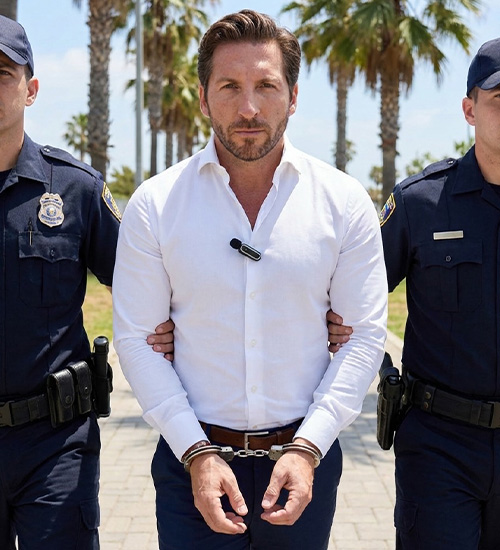
Welcome to the page where we reveal stories of clients, lenders, and former collaborators of Samana Group. All stories have one thing in common: unpaid financial obligations and many months of demanding their rights. Conducting by Zmysłowski of apparent negotiations that are meant to buy time, applying pressure and intimidating with lawsuits, proposing settlements and failing to comply with them.
On this page we present not only stories, but also irregularities in conducted communication, ways of misleading investors, creating a false image of success and actions that may have a criminal character, aimed at obtaining financial benefits for its founder, Marek Zmysłowski.
Topics we have addressed:
- Crowdlending
- Samana Landbank Trust
- Misappropriation of company real estate
- Money laundering through cryptocurrencies
- Unreturned reservation fees after failure to meet contractual conditions
- Conflicts with shareholders and partners
- Lack of personal assets of Zmysłowski
- Private expenses financed from Samana Group funds
- Zmysłowski's drug problems
IMPORTANT! Samana Group reported this page and it has been removed from Google search results. Samana Group has also purchased the domain scamsamanagroup.com to publish their explanations at this address. They want to silence us. Therefore send this link to your friends so they are aware of the update.
Story of Mr. Przemek
We open the latest update with the story of Mr. Przemek. Mr. Przemek (the name has been changed at his request) contacted us several times. He described a problem which – as he claims – affects a group of more than 20 lenders connected with Samana Group projects.
Mr. Przemek lent money within crowdlending. As he reports, since June 2025 he has been unsuccessfully trying to recover his funds. Loan repayments occur irregularly, after multiple reminders, and their amount is approximately PLN 1000. Someone who lent e.g. PLN 70,000 at 14% per year currently receives an amount of PLN 1000 every few weeks (!!!).
In this way the company wants to secure itself against potential lawsuits and then explain that "the company was fighting for survival, but nevertheless settles its liabilities".
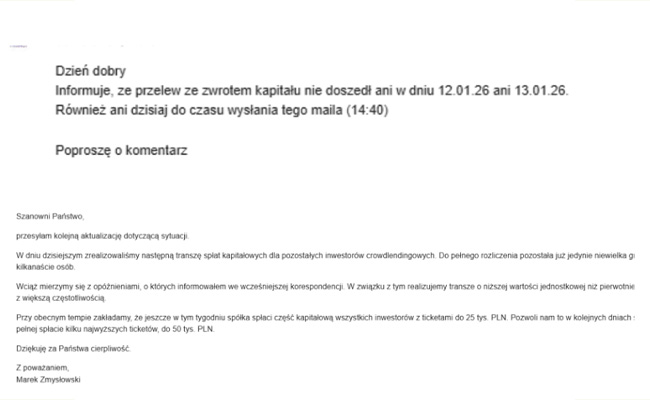
TRANSLATION:
Good morning,
I would like to inform you that the transfer of the capital refund did not take place on either 12.01.26 or 13.01.26. It has also not been completed today as of the time of sending this email (14:40).
I kindly ask for a comment.
TRANSLATION:
Dear Sir or Madam,
I am sending another update regarding the situation.
Today, we completed another tranche of capital repayments for the remaining crowdlending investors. Only a small group of several dozen people remains to be fully settled.
We are still facing delays, which I informed you about in previous correspondence. Therefore, we are executing tranches of a lower unit value than originally planned, but with greater frequency.
At the current pace, we assume that still this week the company will repay the capital portion for all investors with tickets up to PLN 25,000. This will allow us, in the following days, to fully repay several of the largest tickets, up to PLN 50,000.
Thank you for your patience.
Yours sincerely,
Marek Zmysłowski
According to Mr. Przemek's account, lenders receive assurances of repayment – the last promise was supposed to concern the end of January. However, some of them stop believing these declarations and consider further steps: reporting the case to the prosecutor's office, notifying the Financial Supervision Authority or a class action lawsuit. As Mr. Przemek writes, "one spark is missing for the case to reach the media and the prosecutor's office".
Mr. Przemek sent us another message pointing out that people who transferred money to Marek are lenders, not investors as Marek Zmysłowski calls them, which – as he emphasizes – has significant legal importance. He also informs that some of them are already sending payment demands, referring to contractual provisions allowing termination in case of non-repayment. Zmysłowski ignores these demands.
The email also contains criticism of the way communication is conducted in social media – on YouTube comments have been disabled, and on Instagram negative posts are allegedly removed, while at the same time there are threats of defamation lawsuits.
Does this story resemble your own? Contact us.
Story of Mr. Zbigniew part 2: defamation lawsuit
Mr. Zbigniew, whose story we have already described earlier, has still not recovered the lent amount, despite signing a settlement in which he completely waives the promised interest. Moreover, he recently received a court letter for alleged defamation of Marek Zmysłowski and his family on the Internet. See below!
Every professional lawyer (and Marek Zmysłowski has many of them) knows that a filing is submitted to the court competent for the place where the prohibited act was committed.
In our opinion the filing was sent to another court solely in order for the court to quickly inform Mr. Zbigniew that such an accusation has been filed. Now the filing will go to the court where Mr. Zbigniew lives and will be analyzed. This will take several weeks or months and will most likely be dismissed due to lack of evidence.
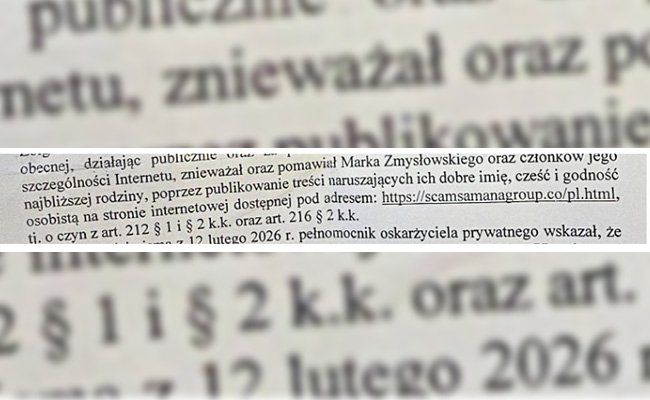
TRANSLATION:
"…acting publicly, including via the Internet, insulted and defamed Marek Zmysłowski and members of his immediate family by publishing content infringing their good name, honor and personal dignity on the website available at: https://scamsamanagroup.co/pl.html, i.e. committing an act under Article 212 §1 and §2 of the Penal Code, as well as Article 216 §2 of the Penal Code."
ATTENTION! This is very characteristic for Marek Zmysłowski, who tries to intimidate investors, clients and former collaborators who are trying to recover their money.
Remember that this is only a way of applying pressure and creating fear in you.
GoWork platform
And speaking of comments, on the well-known platform GoWork Samana Group Poland https://www.gowork.pl/opinie_czytaj,25770937 one can notice positive comments created almost every day by Marek Zmysłowski. This usually happens in the middle of the night Polish time, when Zmysłowski together with his bot creates comments from the Dominican Republic. He invents names of clients and employees who never existed in Samana Group in order to improve the overall rating on the Internet. Former collaborators, investors, clients and lenders complain to us in emails that their negative entries are removed or blocked. Is Zmysłowski afraid of the truth? The answer is: YES.
The Forbes article… is a paid advertisement
On February 5, 2026 Samana Group boasted on its Instagram profile that Forbes Dominican Republic wrote an article about them. "For the first time ever a Caribbean-based project passed Swiss capital market due diligence — one of the most demanding financial frameworks in the world. Forbes explains how embedding governance, sustainability and investor protection directly into a fiduciary trust made this milestone possible."
Forbes did not write any article. SG bought a sponsored article for several thousand dollars, i.e. an advertisement in Forbes. Anyone can do it. Do not be misled.
Soon we will publish more such stories!
Marek Zmysłowski responds to allegations of drug problems
Zmysłowski became very concerned about the information we published in December 2025, confirmed from various reliable sources, regarding his drug problems. So much so that he decided to reverse the narrative and on January 14, 2026 joined the board of a foundation supporting people with addictions. We regret that a hypocrite sits on its board. But this is not the first foundation of Zmysłowski whose real purpose is to mislead people.
Perhaps some of you would like to encourage Ms. Kotańska to familiarize herself with the content of this page. It is a waste of these people's energy to be puppets in the hands of a fraudster.
https://rejestr.io/krs/1217087/fundacja-im-marka-kotanskiego-dotkniecie-dobra
ATTENTION! Soon we will publish stories of more clients, lenders and former collaborators drawn into apparent "negotiations" with SAMANA GROUP. This will be a publication that will not only attract attention but will force uncomfortable questions and leave more than just an echo.
We debunk the lies of Marek Zmyslowski and Samana Group – it’s time for Samana Landbank TRUST - READ UNTIL THE VERY END!
Protect yourself from decisions you may regret. We conduct due diligence on your behalf.

Investments in Samana Group benefit only Samana Group
In recent years, Samana Group, led by Marek Zmyslowski, has conducted numerous investment campaigns: from Emiteo and crowdlending on Crowder offering 15–16% annual returns, through fundraising for Hacienda Cocuyo, to its latest product, Samana Landbank Trust, marketed as a safe, institutional, land-backed investment.
On paper, everything looks impressive. In practice, however, the financial model is becoming increasingly risky, and subsequent fundraising rounds appear primarily designed to plug earlier obligations.
Below, we explain step by step why investors should exercise extreme caution.
📈💔
Crowdlending: attractive promises, real problems
Samana Group encouraged investments starting from as little as PLN 500, promising:
- 12–16% annual returns,
- quarterly interest payments,
- full capital repayment after 12 months,
- a “triple security system”.
At the same time, warning signs began to emerge:
- repayment delays,
- difficulties servicing obligations on time,
- no possibility of early exit.
In practice, investors become fully dependent on whether Samana Group is able to attract new contributors to maintain liquidity. The so-called “security” relies solely on the personal guarantee of Marek Zmyslowski, who openly declares that he has no personal assets because everything is invested in the project. This renders the guarantee economically meaningless.
Hacienda Cocuyo fundraising – promises not fulfilled
The project was promoted as:
- a stable, operating hotel,
- valued at USD 5 million,
- generating over USD 1.1 million annually,
- highly rated on Booking, Google, and TripAdvisor.
In reality:
- the declared value of this three-star property was significantly overstated,
- funds were not used for their stated purpose,
- investors reported a lack of transparency,
- part of the raised capital was redirected to another project.
At this stage, a clear pattern emerges: when a project fails to generate sufficient cash flow, new capital is required.
New product: Samana Landbank Trust – professional narrative, no real security
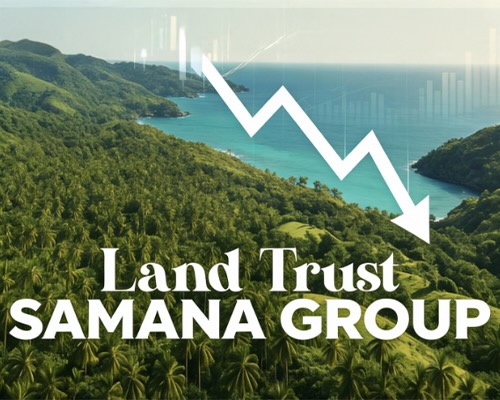
When crowdlending and Hacienda Cocuyo were no longer sufficient, Samana Group introduced another concept: the Landbank Trust. It is advertised as an institutional-grade, secure investment featuring:
- 12% annual returns,
- a Swiss ISIN,
- a “collateralized loan”,
- 185% asset coverage,
- an option to convert into real estate.
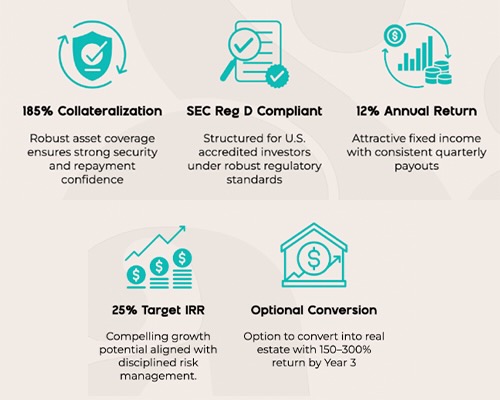
It sounds solid. But…
Key figures are significantly overstated
According to Samana’s own materials:
- land was purchased for approximately USD 5 per square meter,
- yet presented to investors at several times that value,
- Phase 1 appeared profitable only on slides, covering a minimal scope of work, far from the scale promised.
When these assumptions are recalculated for the planned 1,000 units, the model simply does not work, even under ideal sales conditions.
“Security” mechanisms do not protect investors
In the Trust’s official “Worst Case Scenario”:
- escrow reserves are depleted,
- the land is put up for sale,
- if unsuccessful, liability shifts to Samana Group,
- if Samana Group lacks funds, Estating takes over the land.
What does this mean in practice?
👉 Investors do not recover cash. At best, they receive land whose market value may be far lower than claimed.
A Swiss ISIN is not a bank guarantee. A Swiss bank is not a party to the transaction and will not reimburse investors. Marek Zmyslowski may simply state that there is no money, repeating a scenario already seen before.
The Trust works only if new investors keep coming in
The mechanism is simple:
- Landbank acquires land cheaply.
- The Development Trust purchases it at a higher price.
- The margin exists only as long as new investor funds continue to flow in.
This is a classic dependence on continuous new capital inflows.
Why is the Landbank Trust so risky?
- This is not institutional-grade security, it is a repeat of crowdlending in a more polished form.
- The safeguards are theoretical.
- Land valuations are disconnected from market realities.
- New capital may be used to service older obligations.
- In case of failure, investors are left with land, not liquidity.
What does this mean for investors?
An investor entering the Trust today:
- cannot exit early,
- has no banking or institutional protection,
- risks receiving land in the Dominican Republic instead of cash,
- may effectively be financing debts created during previous fundraising campaigns.
In short:
👉 Landbank Trust investors may be financing a budget gap, not genuine project development.

FACTS VS. LIES
After publication of our analysis, Marek Zmyslowski released an “Open Letter” attempting to discredit the findings. This was expected. Below, we focus strictly on verifiable facts.
Claim: a property was never intended as loan collateral
The investment was communicated as being secured by real estate. However, the property was later sold without transparent disclosure. The issue was raised during an investor webinar.
Marek Zmyslowski claims: “The apartment was never collateral; it was sold as a non-core asset.”
Evidence: a webinar recording in which Marek Zmyslowski states something entirely different.
He explains that the property in Szczecin could not secure a satisfactory loan amount and was therefore sold to obtain cash. This directly contradicts later claims that it never served as collateral.
Where is the money? Where is the security?
Crypto wallets and money laundering concerns
We state that cryptocurrency transfers formed part of a money-laundering chain. Marek Zmyslowski disputes this, claiming incorrect amounts and misidentified wallets.
Evidence to the contrary:
- an investor from Barcelona received a private crypto wallet address directly from Marek Zmyslowski, not a corporate one,
- Samana Group does not maintain an official crypto wallet,
- transactions were conducted privately, outside any formal legal or sales structure.
Funds entering this wallet disappear just as quickly.
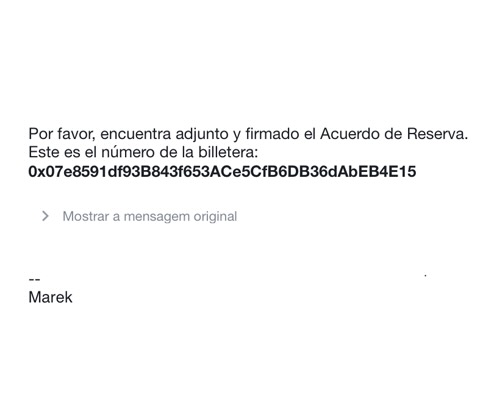
Wallet number: 0x07e8591df93B843f653ACe5CfB6DB36dAbEB4E15
Funding wallet: 0x3247f6b6A45D3Eb307 [According to Etherscan, this is the address that funded the main wallet on Ethereum (i.e., covered the initial gas fee).]
On-chain data analysis clearly identifies wallet 0x3247f6b6A45D3Eb307 as the funding source for the entire operation. This specific address covered the initial gas fees for the main wallet on Ethereum which, according to Etherscan data, establishes a direct link to the operator or founder of the scheme. This connection serves as key evidence linking the infrastructure creator to the subsequent flow of funds.
The first stage of the operation involved the mass collection of funds from investors using the collection wallet 0x07e8591df93B843f653ACe5CfB6DB36dAbEB4E15. Transaction analysis from March 2025 shows high activity on this address, which received dozens of deposits from various individuals. This wallet functioned as a central deposit point where capital was accumulated prior to its final transfer.
The final stage of the scheme took place on the Polygon network, where the operator initiated a series of outgoing transfers once a sufficiently high amount had been gathered. The vast majority of the funds, totaling 727,500 USDC, was moved out in March 2025. This precise capital movement mechanism, confirmed in the CSV files [available for independent verification], documents the complete path of the funds—from investor deposits to their final liquidation by the perpetrators.
Reservation fees were not refunded
Multiple investors withdrew from projects but did not receive reservation fee refunds.
Examples include:
- an investor from Miami who lost USD 5,000 after discovering the purchased plot was unsuitable,
- no alternative was offered,
- the refund was denied,
- the land remains undeveloped to this day.
An investor from New York reported an identical scenario. These cases are not isolated.
False claims about a class action lawsuit
Zmysłowski urges investors to join a class action lawsuit – he's lying again
Marek Zmysłowski, who heads Samana Group, is once again trying to exert pressure on investors by claiming that "more than half" of them have already declared their intention to participate in a class action lawsuit against other shareholders. However, according to our conversations with several investors, no one has confirmed their participation. Zmysłowski seems to be using manipulation and false information once again to convince others to join a case whose outcome is still uncertain.
Similar manipulations, similar lies
In the emails he sends to investors, Zmysłowski promises compensation from a potential settlement in the lawsuit. The problem is, the lawsuit has not even started yet, and the claim that the case has already been "won" is simply untrue. He appeals to investors, telling them that they can count on a share of the potential compensation, but no one knows if the case will even end favorably.
Moreover, Zmysłowski assures that all costs associated with the lawsuit will be covered by the company, and investors will not have to contribute any additional funds. While this might sound attractive, it’s important to question whether this "offer" is just part of a larger strategy to gain support for a questionable venture.
What is really happening with the lawsuit?
First of all, the claim that "more than half of the investors" have already joined the lawsuit seems to be just another manipulation. Regardless of how many people actually want to participate in the case, the fact remains that Zmysłowski has not presented any evidence that his words have any basis in reality. We spoke with several individuals who are investors in Samana Group, and none of them confirmed their participation in the lawsuit.
Such actions raise concerns. Instead of focusing on actually resolving the issues, Zmysłowski seems to be using misinformation to exert pressure on the remaining investors to join the lawsuit in the hope of a quick resolution and compensation.
A warning to investors
Before deciding to join the lawsuit, it’s important to carefully consider the situation and seek legal advice. History shows that similar attempts at manipulation can lead to bigger problems and a loss of funds, rather than bringing the expected benefits. Instead of trusting Zmysłowski’s assurances, it’s better to proceed with caution and consider all available options.
Investing in such initiatives carries risks, and Zmysłowski’s current behavior only raises doubts about his reliability and intentions.
The story of another investor – an example of fraud
Another investor invested USD 50,000 and has not received repayment for over a year. The loan was personally guaranteed by Marek Zmyslowski with his “entire assets”, which, as established, do not exist. All assets had already been liquidated.
The investor is desperately attempting to recover funds. Samana Group has removed some of their online comments using paid moderation tools, including a premium profile on GoWork that allows review management. These posts will be presented as evidence.
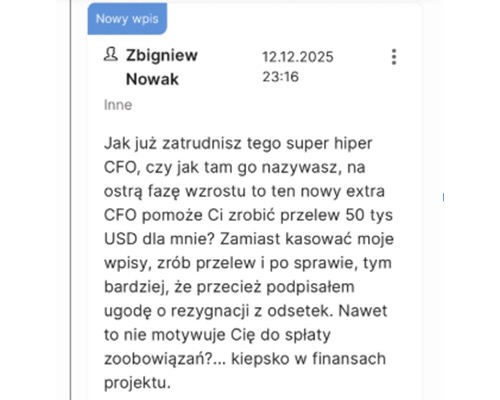
Legal analysis
This conduct meets the definition of fraud under applicable law: misleading investors for financial gain by creating a false sense of security, including guarantees made without assets and concealment of insolvency.
Filing a criminal complaint allows authorities to access company documents, bank records, tax data, and compel testimony. This significantly strengthens any subsequent civil claims and may allow asset seizure if assets are identified.
Failure to act increases the risk of evidence disappearing, assets being hidden, and claims becoming time-barred.
We are here to show the truth
Filing a report with the prosecutor is not an aggressive step. It is a protective one. If no grounds are found, nothing happens. If grounds exist, it opens a real path toward recovering funds.
If you are an investor in Samana Group and wish to assess your situation, contact us. We can help analyze your case and prepare the necessary documentation.
We continue to receive messages from both local and international investors expressing outrage and disbelief at the scale of deception.
The purpose of this page is solely to expose the lies spread by Marek Zmysłowski and to highlight the risks associated with investing in his projects. The publication aims to protect potential investors from financial loss by providing them with accurate information about dishonest practices and false promises.
The money you invested was supposed to bring you a real return? You dreamed of a house with an ocean view? Instead, all you get are empty promises. You are fed stories about lack of funds, recovery plans, issues with construction companies, yet at the same time you see Marek Zmyslowski and Yaritza Reyes living a luxurious life.
Have you ever wondered who is funding that lifestyle? We’ll answer: IT’S YOU.
Sit down. What you’re about to read will not be pleasant.
According to our calculations (conservative ones), over the last two years more than 13,500,000 USD has flowed into Samana Group from investors. What happened to this money? The information we gathered comes from investors, employees and partners of Samana Group. Do you want to add something? Contact us. You’ll find our email address at the end.
We reached out to clients who invested in the apartments in Nomad City Condo. It turned out that to this day there are no official plans approved by Dominican authorities. There aren’t even foundations yet. Some clients bought their apartments as far back as two years ago. During our investigation, it turned out that the same apartment had been sold to several different clients. Contracts were signed for identical units.
Didn’t it ever strike you that in every Samana Group photo there’s always the same single excavator? Why is there still just a hole in the ground?
Remember Casa Hybrid in El Valle? That property (a company asset) was quickly sold to avoid creditors. The money was swiftly moved out of the company. What’s more, Marek Zmyslowski signed reservation agreements with multiple clients and has still not returned their reservation fees of 5,000 USD.
Empty promise
You may remember how Marek and Yaritza promised 5,000 USD for women who wanted to start a business in Samana (Foundation link). They recorded one video showing an alleged beneficiary, but the whole thing was staged. The video features only close associates of Marek Zmyslowski. Emails with applications went straight to the trash. Women in Samana received no support at all.
Have you wondered why Yaritza Reyes, a professional model, suddenly decided to win the hearts of Poles by joining TOP MODEL or appearing in advertising campaigns? You’re smart. Think about it.
Have you read this article? You’ll find many similarities there to what is happening in Samana Group and Marek’s activities in Africa, especially information on how Marek had conflicts with his partners. The scenario repeats itself, and Zmyslowski is always “the victim”.
“But Marek cleared himself of all accusations, I read the book,” someone may say. We have witnesses who say they heard from the author himself that much of that book is literary fiction created for narrative purposes.
Conflicts with partners
And since we’re speaking about partner conflicts… Marek claimed he fell into dispute with “minority shareholders” but he never said who these shareholders were. He always called them minority shareholders, but the truth is different. They are Shannon Robertson and Tomas Avogadro, the co-founders of the project. Doesn’t it strike you that the two closest people ended up in conflict with Marek Zmyslowski?
By the way, Marek Zmyslowski has fallen into conflict with everyone he paid: employees, investors, partners, construction subcontractors, architects, brokers and the marketing agency, always claiming the other side was at fault. The real reason behind these conflicts is payment delays.
On November 30th, a response from Zmyslowski appeared on this platform, with the following content: “Referring to the insinuation of 'continuous Vacation' - it just doesn't respond to reality. The last two-day trip with my wife took place two years ago, in the form of a wedding gift from a partner. We spent our last full vacation over three years ago. The last three years have been a time for us to focus on work and on solving challenges that we communicate transparently about from the very beginning”. Really? The photos tell a different story. We also reached participants of the Miami event from November 27th, 2024.
“The meeting was held in a small group. Yaritza and Marek were in a big hurry. One real estate agent asked Yaritza why we were ending the meeting so quickly. She replied that they were flying early the next morning for their honeymoon trip to Turkey.”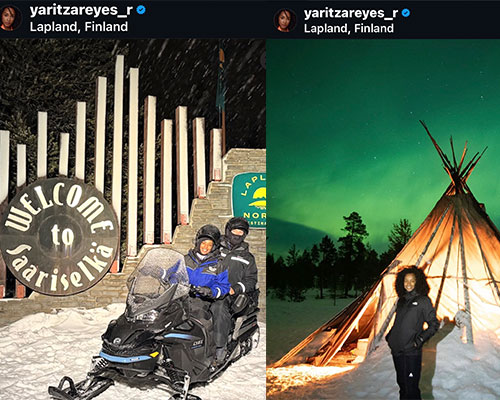

Where is the money?
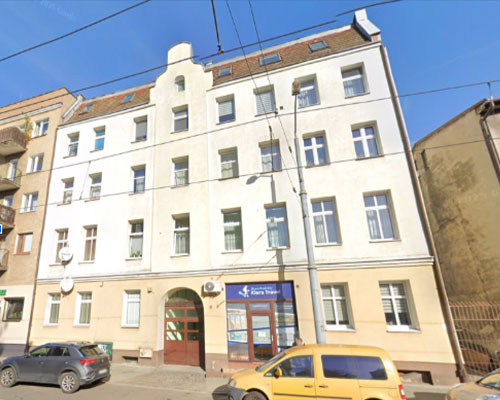
We have also obtained information about an investor who handed over his apartment as an asset swap in exchange for a house in Nomad City. The apartment in Szczecin (Poland), according to Marek’s promise, was supposed to secure all Polish investors. However, it was sold a few months ago, which Zmyslowski confirmed during the spring webinar. "In the end, the result is the same... There was a significant issue with obtaining a satisfactory loan amount. The lenders simply did not accept the appraisers' valuations and offered loan amounts that were only 25% of the amount declared by the appraiser." Why did he do it quietly and only explain it in a defensive manner when an uncomfortable question was asked?
Samana Group’s website no longer shows all the faces of the project. Have you wondered why? These people figured out what was going on. Those who genuinely wanted to build the project are no longer working with him. People who were with him daily. Why did they suddenly walk away overnight?
Have you wondered who is actually responsible for construction in Nomad City? Someone with no experience whatsoever in development projects. Privately, it’s Yaritza Reyes’ sister - Belen Reyes. Have you wondered why Marek Zmyslowski is suddenly looking for a CFO? Someone will become the scapegoat.

Broken Agreements
Investor webinars are still held on moderated platforms where participants cannot appear on camera nor speak, and can only ask written questions, which are moderated before the hosts read them. Supposedly an open meeting for everyone is scheduled for December 1, 2025 - it may happen for the first time.
We spoke to many investors who have been waiting months or even years for their money to be returned. On average, every three months they received letters from the company, specifically from Marek Zmyslowski, about alleged problems. In one of the letters, Marek promised that if by June 30, 2025 he did not return the funds with interest, the company would be recapitalized by the founders. This did not happen, despite his official sale of shares in SunRoof.
Let’s talk about shares in Samana Group. To this day, most people who were supposed to receive shares have not received them. Once again SG violated the agreements. And what about loans? Of course, missing or delayed interest payments and pressure to convert loans into shares or into construction of an apartment. Want to receive cash? That’s not possible, even though the assurances were different. The high promised return was only meant to lure investors.
Zmyslowski repeatedly claimed he was putting all his private funds into the NOMAD CITY project. So who is sponsoring his participation in racing training and car races that he frequently joins? How much is the apartment in Złota 44 in Warsaw (Poland) that he and Yaritza have been renting for months? We checked. It is over 40,000 PLN / 11,000 USD per month. It seems this contradicts everything he says - he is not investing “everything into his life project”, instead the “life project” is funding their inflated lifestyle.

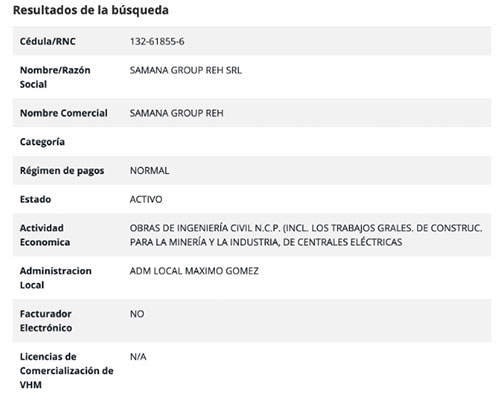
Has anyone been informed that Zmyslowski opened a new company in the Dominican Republic with a similar name? It is called GRUPO SAMANA REH SAS, tax number 133-45383-5. A similar name. Why did this happen quietly? Is this an attempt to “start from zero”?
By the way… are you aware that Marek has serious drug problems? He regularly uses cocaine. We have spoken to party acquaintances and obtained information about his rehab. Yes, he doesn’t just “supplement testosterone”. He did it in Nigeria, he does it in Poland and in the Dominican Republic.
We also confirmed that Michał Ptasznik, the Sales Director, is hiding from clients and investors. He even changed his phone number and social media accounts to avoid contact with investors and clients of Samana Group. Previously, however, when signing a sales or investment agreement, he was available even late at night. Once problems appeared, he avoided responding or stalled.

Perhaps you paid to Samana Group in cryptocurrency? We encourage you to thoroughly check the wallet to which you transferred funds (anyone can do it, this data is public): is it linked to other wallets? Are your funds still there? We identified the path the money took from one wallet alone (over 730,000 USD). We determined that instead of investing, Marek immediately sent the funds through a complex chain of anonymous wallets, which is a classic money laundering scheme used to hide the trail.
Legal Actions
If you still lack evidence that Samana Group is a scam, read what others say: GoWork.pl.
In our opinion, payment delays are intentional actions aimed at siphoning money out of the company. Fraud is a crime.
If you feel deceived, we encourage you to report this to the Polish Prosecutor’s Office. The scale of the fraud is enormous. We are talking about a minimum of 50 million PLN. These are conservative estimates. Do not let yourself be fooled any longer. This site aims to warn you against SAMANA GROUP and to encourage you to contact law enforcement. Do not be afraid. We want to warn you about Marek Zmyslowski and his wife, Yaritza Reyes, who is currently trying to build her personal brand in Poland. You cannot allow this. Every report to the Prosecutor’s Office will help ensure that those responsible for the fraud are arrested, charged and held accountable.
If Samana Group delays payment of your invoices claiming they have no money (while Marek and Yaritza use company funds for their luxury lifestyle), this is a crime under Art. 300 §2 of the Penal Code (hindering or reducing creditor satisfaction). Other crimes include:
- Art. 286 §1 (fraud)
- Art. 296 §1 (causing damage in economic relations)
- Art. 301 §1 (creditor prejudice)
- Art. 299 (money laundering)
If you suspect anything - do not wait, report the case to the prosecutor's office. Write a notice of suspected criminal activity. Authorities are obliged to investigate. Do not fear anything.
Report the case to the prosecutor's office:
Pomorski Wydział Zamiejscowy Departamentu do Spraw Przestępczości Zorganizowanej i Korupcji w Gdańsku,
81 - 840 Sopot, Aleja Niepodległości 741 B
E-mail: biuro.podawcze.wzgda@prokuratura.gov.pl
Do you want us to publish your story so others can see it? Let it no longer be seen as a 'made-up' story, a 'attempt to get money back,' or an 'attack on Zmysłowski,' but a way to show others that you’ve been deceived.
Contact for media representatives who want to learn more:
E-mail: scamsamanagroup@proton.me
Related in-depth analyses
For readers who want to dig deeper into a specific angle of the Samana Group case, we have published three focused investigations:
- Marek Zmyslowski fraud history: Nigeria, Poland, Dominican Republic — the timeline showing how the same scenario keeps repeating across three continents.
- Samana Landbank Trust review: Swiss ISIN, real risk, no bank guarantee — what the “institutional-grade” structure actually protects, and what it does not.
- Nomad City Condo Dominican Republic: investor warning & buyer guide — reservation fees, duplicate sales and the due-diligence checklist before you sign.